
home > treatments > lumbar (lower back) fusion
Lumbar fusion
Fixing vertebrae in the lower back
What is a fusion or fixation?
In a fusion (spondylodesis), two or more vertebrae are fixed to each other with screws, rods and usually an interbody cage. Over the following months they grow together into one stable unit. The aim is to settle a painful or unstable segment of the spine and to give trapped nerves more room permanently.
Fixation is the stabilisation with screws and rods itself; fusion is the bony healing that follows. In practice, the two terms are used together.
When is a fusion needed?
Only when there is a clear reason:
- instability of a spinal segment;
- a slipped vertebra (spondylolisthesis) that causes symptoms and for which a decompression alone is not sufficient;
- severe wear and tear with nerve compression that cannot be resolved with a smaller procedure, for example due to narrowing of the nerve canal that can only be relieved by opening and fixing the segment;
- certain fractures, injuries or deformities.
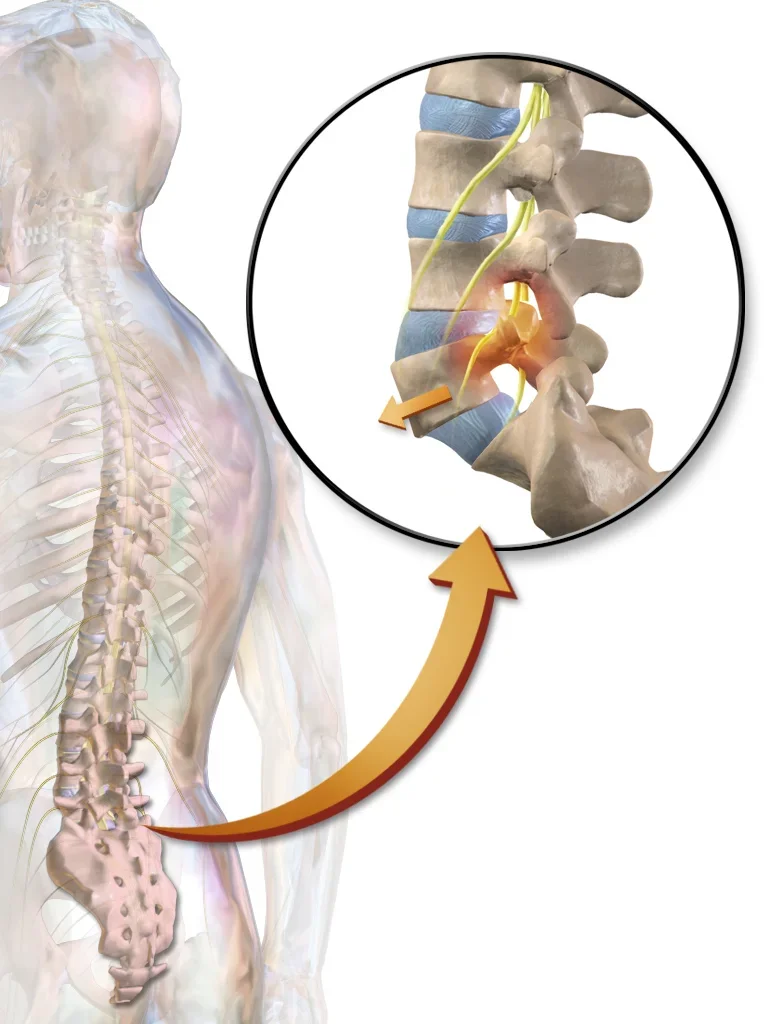
A fusion is a bigger procedure than a disc herniation operation or a decompression. That is why, at the consultation, we always first look at whether less will do. Large comparative studies show that in spinal stenosis without clear instability, and also with a limited slippage of a vertebra, a decompression alone usually gives as good a result as a decompression with fusion, with a shorter operation and hospital stay. One American study did find a benefit of fusion for a grade 1 slippage (fewer reoperations, better physical scores after 2 to 4 years), so the choice is made for each patient individually. If a smaller procedure is sufficient, it is preferred.
For low back pain due to wear and tear without nerve compression, instability or slippage, Belgian (KCE) and British (NICE) guidelines advise against fusion, except after failed multidisciplinary non-surgical treatment and after multidisciplinary discussion. In that situation the result is too unpredictable.
Has a fusion been suggested to you elsewhere? You can see Dr Lavrysen for a second opinion. Please bring your imaging.
What does the procedure involve, and what does "minimally invasive" mean here?
The procedure is performed under general anaesthesia. Its duration depends on the number of levels and the technique.
Planning tailored to your spine. Dr Lavrysen specialises in assessing the spine using spino-pelvic parameters: the relationship between the position of the pelvis and the curve of the lower back. We measure these relationships on a standing X-ray of the whole spine, and every reconstruction is tailored to them: how much curve (lordosis) the fixed segment should have, which cage fits and by which route it is best placed. This is supported by scientific evidence: in a retrospective study after lumbar fusion, patients whose curve fell short by more than 10° relative to their pelvic shape had an approximately ten times higher risk of reoperation for wear of the adjacent level (Rothenfluh et al., European Spine Journal 2015).

Percutaneous screws. Where the anatomy allows, the screws are placed through small stab incisions in the skin, under X-ray or navigation guidance. The back muscles are then not detached over a long distance. Less muscle damage means less pain after the procedure, getting up sooner and a smoother recovery.
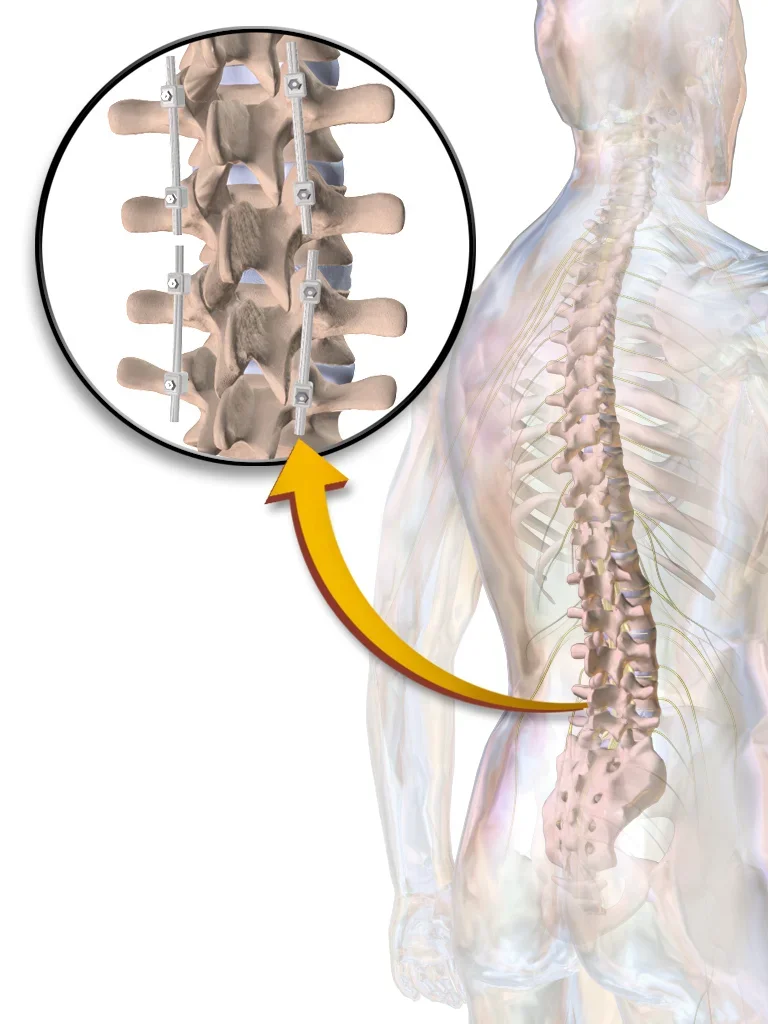
Microscope and nerve-sparing technique. Freeing the nerves and placing the cage are done under the operating microscope, through as limited an approach as possible. In a PLIF or TLIF, Dr Lavrysen works with as little traction on the nerves as possible: the access to the disc is chosen so that the nerve root and the dural sac only need to be held aside minimally and briefly.
Neuronavigation and 3D-printed drill guides. To place the screws precisely, Dr Lavrysen uses, where possible, the latest neuronavigation system, which works like a GPS during the procedure based on a 3D scan taken in the operating theatre. He also places screws through the midline using custom 3D-printed drill guides, designed in advance on the patient's CT scan and fitting exactly onto the vertebrae during the operation. This allows a smaller approach and spares more muscle. In a recent network meta-analysis of 133 studies with more than 88,000 screws, navigation, robotic surgery and 3D-printed drill guides all improved accuracy compared with the conventional technique; the drill guides had the lowest risk of a misplaced screw (Eid et al., 2026).


Approaches. Depending on the condition and the anatomy, the cage is placed through the back, through the side or through the abdomen. Dr Lavrysen specialises in the lateral (XLIF) and anterior (ALIF) approaches, alongside the conventional approaches through the back:
- PLIF / TLIF (PLIA): cage and pedicle screws through the back itself; with TLIF slightly more from the side, so that less traction on the nerves is needed.
- XLIF: cage through a very small incision in the side of the abdominal wall.
- OLIF / OLIA: a variant of the lateral approach, slightly further forward.
- Mini-ALIF / ALIA: cage through a small incision at the front of the lower abdomen.
- Percutaneous fixation: screws only, through the skin, without a large incision, for example for certain fractures.
- Cervical reconstructions: fixations of the neck vertebrae, mainly after accidents.
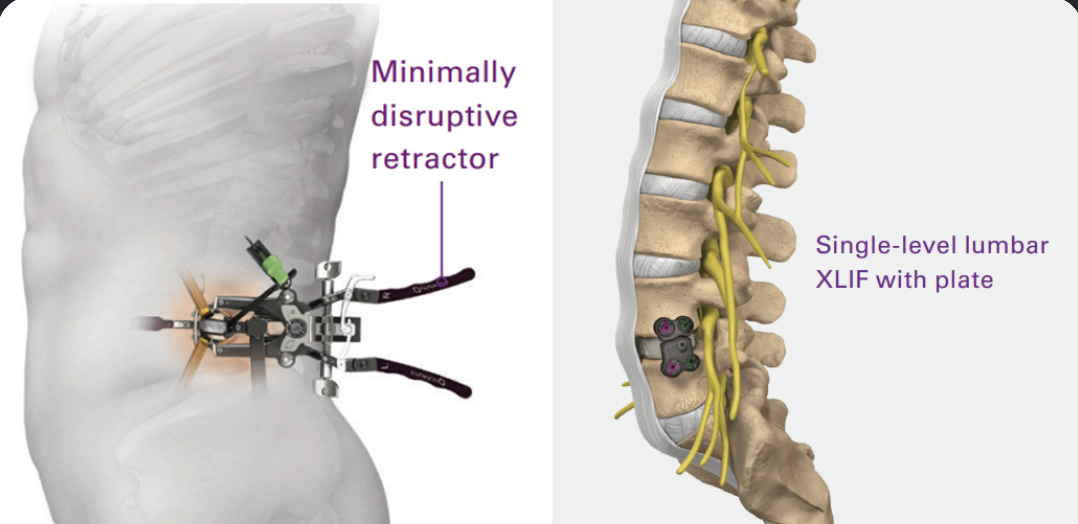

For this, Dr Lavrysen works in a multidisciplinary setting with colleagues from neurosurgery, orthopaedics and vascular surgery. The condition and the person determine which procedure is needed; the ultimate goal is the best and safest possible result.
What is the recovery like?
You usually stand up the day after the procedure and stay in hospital for a few days. For the first six weeks, avoid lifting, deep bending and twisting; walking is strongly encouraged. Desk work is often possible after four to six weeks, physical work later and in consultation. You can drive when you can move easily and no longer take strong painkillers.
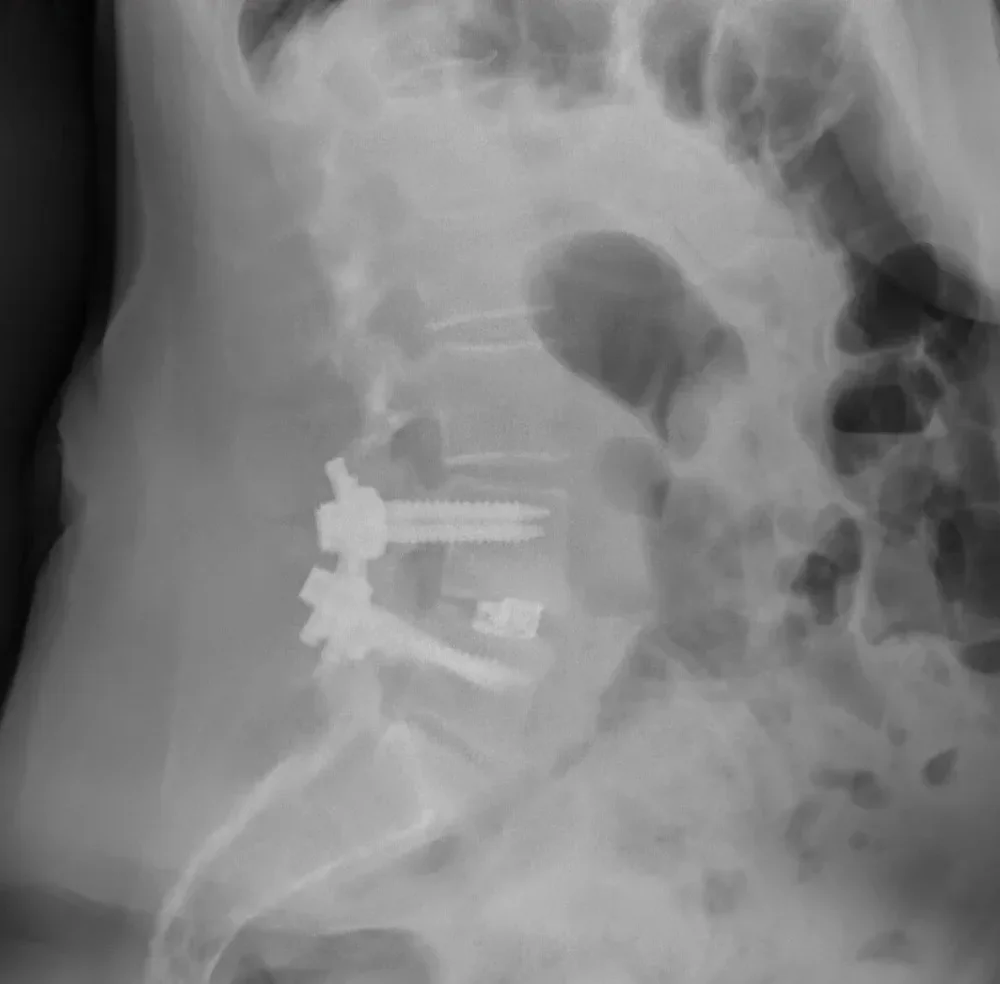
The fusion of the vertebrae takes a few months. At the follow-up appointments we monitor this with X-rays or a CT scan. Physiotherapy supports the process: first posture and gentle movement, later building up strength and endurance. Smoking slows down the fusion; stopping before the procedure is strongly recommended.
What are the risks?
As with any back operation, there are general risks: post-operative bleeding, infection, a small tear in the membrane around the nerves (in large series in about 4 to 6 in 100 operations through the back, usually repaired during the procedure) and, rarely, nerve damage with weakness or altered sensation. Specific to a fusion:
- Incomplete fusion (pseudarthrosis): does not always cause symptoms, but may require another procedure. The risk is higher with smoking, multiple levels and certain conditions such as diabetes or osteoporosis.
- Problems with screws or implants: misplaced, loosened or broken screws; navigation and drill guides reduce this risk.
- Extra strain on the adjacent levels in the long term, because they take over the movement of the fixed segment. As a result, some patients develop new symptoms years later.
- A bigger procedure than a decompression: in comparative studies, fusion led to more blood loss and a longer hospital stay (on average 4 to 7 days compared with 3 to 4 days for decompression alone).
We discuss these risks with you in detail. For this procedure, a well-informed decision is even more important than for other procedures.
Frequently asked questions
Will I be stiff after a fusion?
The loss of mobility from one or two fixed levels is usually hardly noticeable in daily life. The rest of the spine takes over a great deal, and bending happens largely at the hips.
Will the metal ever be removed?
Usually not. The implants stay in place and rarely cause problems. Only if there are problems with the implants or during another procedure are they sometimes removed or replaced.
Can a fusion be done minimally invasively?
Often, yes, with percutaneous screws and a limited approach under the microscope. Whether that is possible depends on the condition and the anatomy. If a fusion has been suggested to you, you can bring your imaging to a consultation to see whether it can be done minimally invasively, or whether less will do.
Does a fusion help with ordinary low back pain?
For back pain due to wear and tear without instability, slippage or nerve compression, the result is unpredictable. Guidelines advise against fusion in that situation, except after failed multidisciplinary treatment and after multidisciplinary discussion. In that case, we first discuss the other options.
What is the difference between TLIF, PLIF, XLIF and ALIF?
They are different routes for placing the cage between the vertebrae: through the back (PLIF, TLIF), through the side (XLIF, OLIF) or through the abdomen (ALIF). The end result, a fused segment, is the same. The choice depends on the level, the nerves that need to be freed and your anatomy.
Related treatments
All treatments →