
home > treatments > cervical disc herniation
Cervical disc herniation
Slipped disc in the neck
What is a cervical disc herniation?
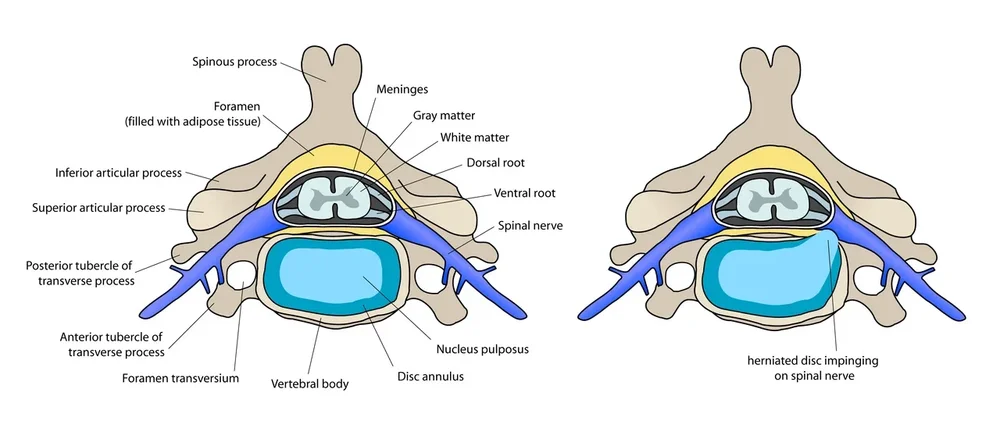
There are intervertebral discs between the neck vertebrae too. Each disc has a soft core and a tough fibrous ring. When part of that core pushes out through the fibrous ring, we call it a disc herniation. In the neck, such a herniation usually presses on a nerve root running to the arm. Less commonly, it presses on the spinal cord itself.
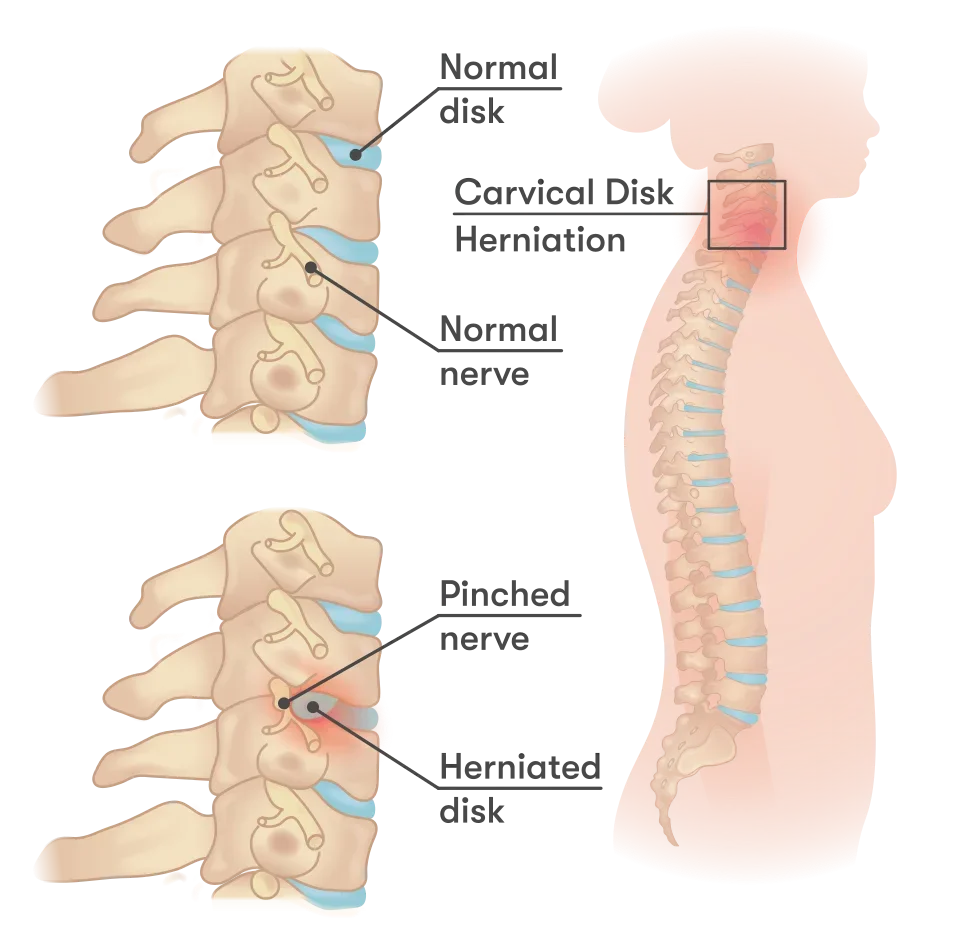
A cervical disc herniation often develops in a disc that is already somewhat worn. It is most common between the ages of 40 and 60, but can occur at any age.
What symptoms does a cervical disc herniation cause?
- Pain radiating from the neck or shoulder into the arm, sometimes down to the fingers.
- Tingling or numbness in the arm or hand.
- Sometimes weakness in the arm or hand.
- With pressure on the spinal cord: clumsy hands, difficulty with fine movements or a change in the way you walk. This calls for a faster assessment.
Which fingers tingle and which muscles are weaker depends on the level of the herniation. This helps us match the symptoms to what is visible on the MRI.
Warning signs: rapidly increasing weakness in the arm or hand, clumsy hands, unsteady walking or bladder problems may indicate pressure on the spinal cord. In that case, contact your doctor or the practice promptly.
How is the diagnosis made?
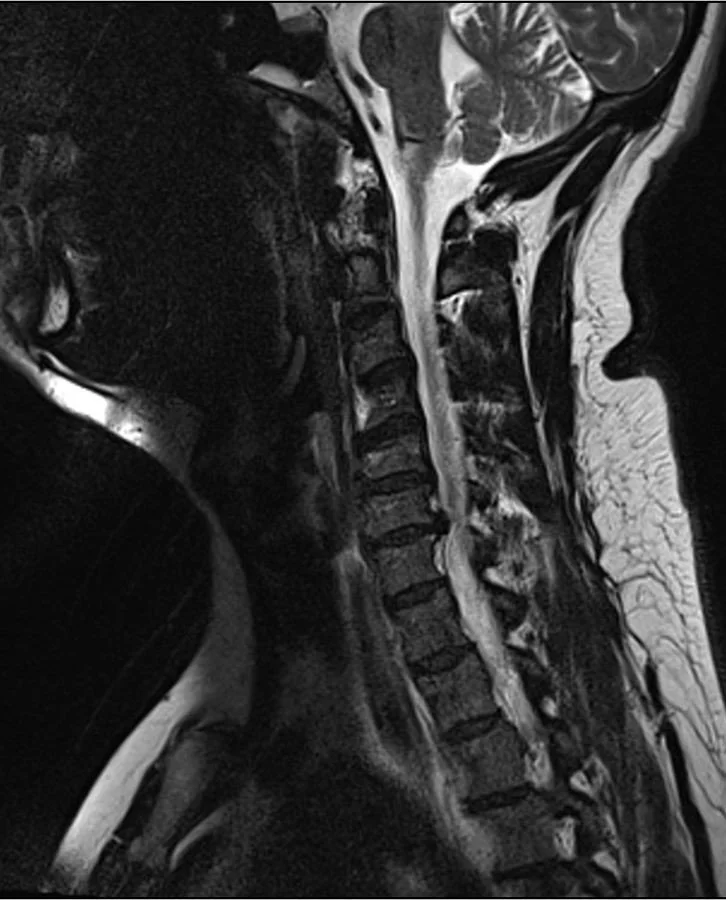
The clinical examination comes first: we test strength, sensation and reflexes in the arms and check whether certain neck movements provoke the pain. An MRI of the neck is the key investigation to confirm the herniation and the pressure on the nerve or spinal cord. Imaging is especially useful when symptoms have not improved after a few weeks or when there is weakness, because the result can then change the treatment.
If there is doubt about the cause of the arm symptoms, a nerve conduction study (EMG) can help to rule out, for example, carpal tunnel syndrome or ulnar nerve compression.
Does a cervical disc herniation need surgery?
Usually not. As in the lower back, most cervical disc herniations heal spontaneously. In most patients the symptoms clearly decrease over the first weeks to months, and the herniation itself often shrinks on the MRI. During this period, treatment consists of painkillers and anti-inflammatories, possibly physiotherapy and sometimes a targeted injection around the nerve root.
Surgery is considered in case of:
- persistent, disabling arm pain that does not improve after 6 to 12 weeks of non-surgical treatment;
- increasing or marked weakness in the arm or hand;
- signs of pressure on the spinal cord (myelopathy). In that case we do not wait.
With arm pain without weakness there is no hurry: waiting is safe, and surgery remains possible if the symptoms drag on.
How is the operation performed?
Through the front of the neck
The most commonly used technique is performed through a small, discreet incision at the front of the neck, in a natural skin crease. Under the operating microscope, the affected intervertebral disc is removed and the nerve root and spinal cord are freed. The disc space is filled with a small cage, after which the two vertebrae fuse together, or with a disc prosthesis that preserves the mobility of the level.

Disc replacement: preserving mobility
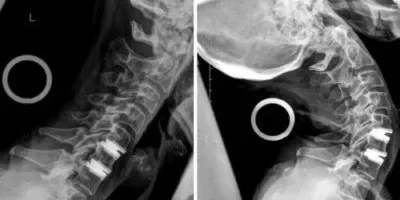
Dr Lavrysen specialises in cervical disc replacement. A prosthesis replaces the worn or bulging disc with a small mobile joint, so that the level keeps moving instead of fusing. In carefully selected patients, this is a good alternative to fusion.
A prosthesis is mainly considered for a herniation or limited wear at one or two levels, in a supple neck and without marked arthritis of the small neck joints (facet joints), instability or osteoporosis. In randomised studies with follow-up of up to ten years, a prosthesis performs at least as well as a fusion, and further operations at the adjacent level appear to be needed slightly less often. With clear arthritis or instability, fusion remains the better choice. During the consultation we look at your images to see which technique is most suitable for you. You can read more about fusion on the cervical fusion page (see related treatments).

Through the back of the neck
When the herniation lies to the side, it can also be removed from the back through a small, muscle-sparing approach (foraminotomy). The intervertebral disc is then largely preserved and no cage is placed. A recent Dutch study of 265 patients showed that, for lateral herniations, this posterior approach gives results after one year that are at least as good as the operation through the front, with fewer swallowing problems but slightly more wound problems.
Dr Lavrysen will discuss with you which approach best suits your herniation and your situation, and why.
What are the risks?
Surgery for a cervical disc herniation is a safe and frequently performed operation, but like any operation it carries risks. These are discussed with you beforehand.
- Swallowing difficulties and hoarseness after an operation through the front: very common in the first days, lasting longer in about 1 in 10 patients, rarely permanent (hoarseness due to injury of the nerve to the vocal cords in 1 to 3 in 100).
- Post-operative bleeding in the neck (1 to 2 in 100) and wound infection (less than 1 in 100).
- Leakage of cerebrospinal fluid due to a small tear in the dura (less than 1 in 100), usually repaired during the operation.
- Nerve or spinal cord injury: very rare, but not impossible.
- Bone formation around a prosthesis: in some patients, extra bone forms around the prosthesis over the years, which can make the level less mobile. Usually this causes no symptoms.
- Wear of the adjacent level after a fusion: in the long term, about 1 in 4 patients develops new symptoms at a neighbouring level within 10 years; some of them need another operation.
How quickly will I recover?
Most patients are up and about the same day and leave hospital after one night. A sore throat and mild swallowing difficulties in the first days are normal after an anterior approach. A neck collar is usually not needed.
The radiating arm pain often improves noticeably quickly after the operation. Tingling and weakness recover more slowly, over weeks to months, and not always completely after prolonged compression. Office work can usually be resumed after two weeks, heavier activities after six weeks, always in consultation. You may drive as soon as you can turn your neck easily and without pain and are no longer taking strong painkillers.
Frequently asked questions
Why operate through the front of the neck?
The herniation usually lies in front of the nerve. Through the front it can be removed directly, without pulling on the spinal cord and without going through the neck muscles. An operation through the back is possible for lateral herniations and then gives comparable results.
How long should I wait before surgery makes sense?
With arm pain without weakness, we generally recommend 6 to 12 weeks of non-surgical treatment, because most herniations clearly improve during this period. With increasing weakness or signs of pressure on the spinal cord, we do not wait that long.
Can an injection avoid the operation?
Sometimes. A targeted injection around the nerve root relieves the pain in some patients, sometimes enough to bridge the period of spontaneous recovery. The herniation itself is not changed by it. With weakness or myelopathy, an injection is not an alternative to surgery.
Will I be left with a visible scar?
The incision lies in a skin crease at the front of the neck and usually becomes very discreet over time.
Will I lose mobility in my neck?
After a single-level fusion, the loss is limited. Most patients notice little of it in daily life, because the other levels largely take over the movement. After a prosthesis or an operation through the back, the level remains mobile.