
home > treatments > meralgia paresthetica
Meralgia paresthetica
Narrowing around the nerve in the groin, with pain in the thigh
What is meralgia paresthetica?
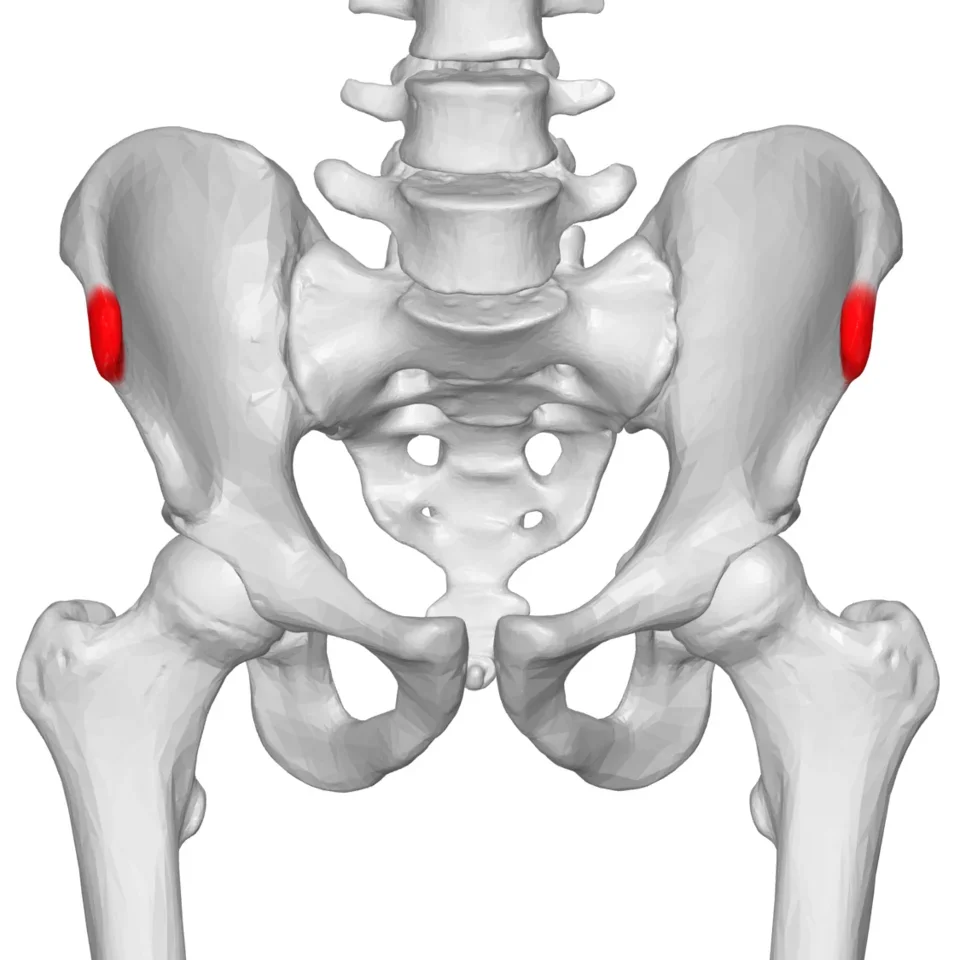
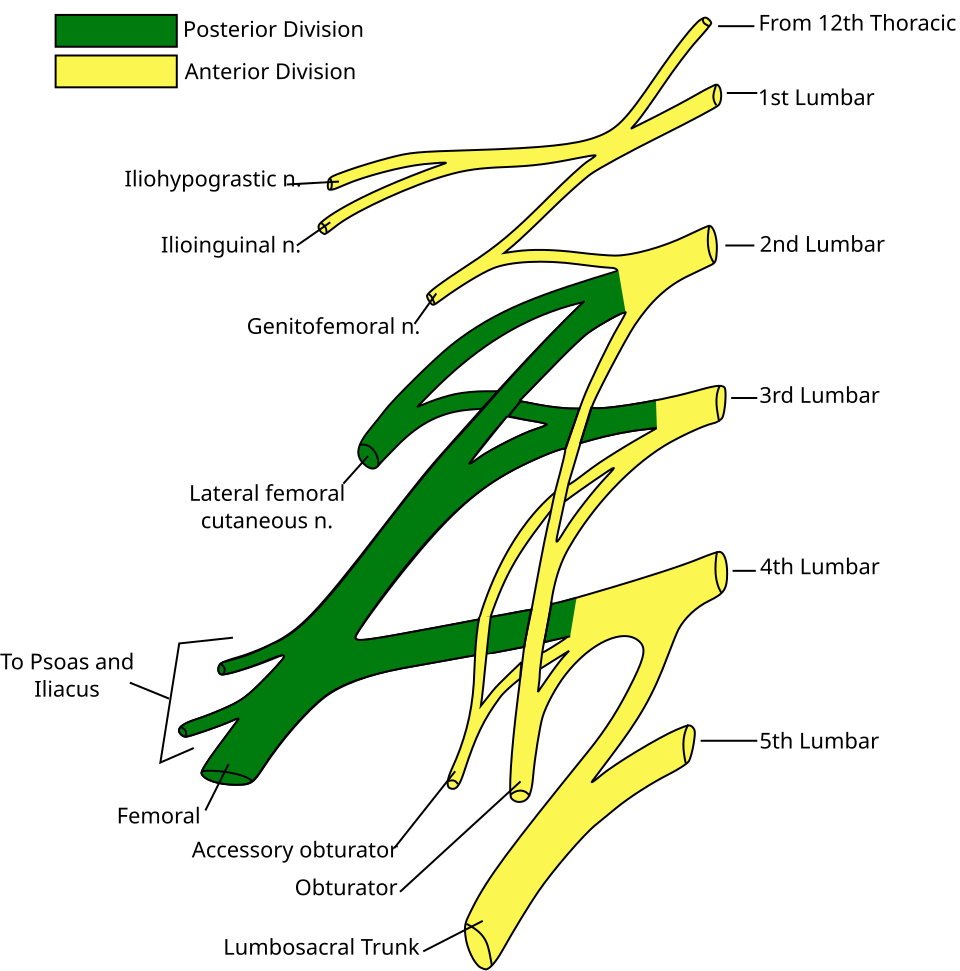
Meralgia paresthetica is a condition in which a small sensory nerve of the thigh, the lateral femoral cutaneous nerve, becomes trapped. This nerve runs from the pelvis to the thigh and passes just beneath the inguinal ligament in the groin. It is precisely at that spot that it can come under pressure.
The result is pain, a burning feeling, tingling or numbness on the front and outer side of the thigh.
Important to know: this nerve only provides sensation to the skin. It does not control any muscles. Meralgia paresthetica therefore does not cause loss of strength or paralysis, and is an unpleasant but benign condition. It affects about 3 to 4 in 10,000 people per year, and is more common in people who are overweight or have diabetes.
Which symptoms are typical?
The symptoms are usually on one side, on the front or outer side of the thigh:
- a burning, prickling or "asleep" feeling
- tingling or numbness in a clearly defined patch of skin
- oversensitive skin, where even clothing rubbing over the skin hurts
- sometimes a sharp, electric pain
The symptoms often get worse with prolonged standing or walking, tight clothing, a tight belt or pressure at the level of the groin.
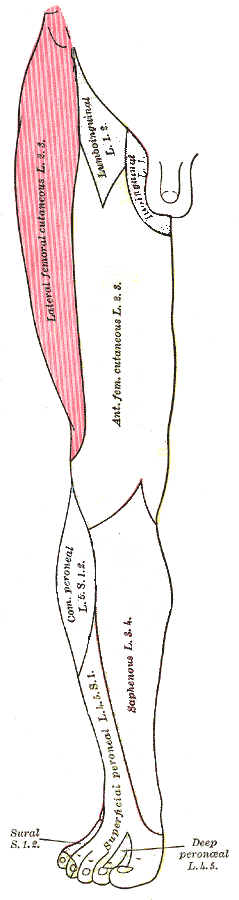
Because this is a purely sensory nerve, loss of strength, the knee giving way, symptoms extending below the knee or marked back pain with radiating pain do not fit the picture. If they are present, we look for another cause, such as a nerve root in the lower back or another nerve of the leg.
Warning signs: rapidly increasing loss of strength in the leg, problems passing urine or opening your bowels, or numbness in the saddle area do not fit with meralgia paresthetica. In that case, contact a doctor the same day.
How does it develop?
The nerve passes through a narrow opening beneath the inguinal ligament. Anything that causes pressure or stretch there can irritate the nerve: tight trousers or belts, heavy tool belts, weight gain, pregnancy, diabetes, scars or previous surgery around the pelvis, hip or abdomen. Lying on your stomach for a long time during an operation can also trap the nerve temporarily. Sometimes there is no clear trigger. In some people the nerve runs a slightly different course, which makes it more prone to entrapment.
Being overweight is a known risk factor, but it is certainly not the cause in everyone: slim people get this condition too.
How is the diagnosis made?
Usually on the basis of the conversation and the physical examination. The typical pattern of symptoms, a clearly defined area on the outer side of the thigh with normal strength and reflexes, already points strongly towards the diagnosis.
Is a scan needed? Not always. An MRI of the lower back or pelvis is mainly requested when the pattern of symptoms is not typical, when there is also back pain or loss of strength, or when it might be a nerve problem coming from the back.
Ultrasound can show the nerve at the level of the groin and where it is trapped, and is used to place an injection precisely around the nerve.
EMG (nerve testing) is technically difficult for this small nerve and less reliable than, for example, in carpal tunnel syndrome. A normal EMG therefore does not rule out the condition. It is mainly useful for ruling out other nerve disorders.
Diagnostic nerve block. The most useful test is a small amount of local anaesthetic around the nerve, under ultrasound guidance. If the pain then disappears temporarily, this confirms the diagnosis. The same injection can also serve as treatment.
Treatment without surgery
Most patients do not need an operation. We build up the treatment step by step.
1. Taking away the pressure. Looser clothing, no tight belt, repositioning heavy work belts. If excess weight plays a role, losing weight can help. In pregnancy, the symptoms usually disappear after the birth.
2. Waiting. In the only study that followed the natural course, about 7 in 10 patients improved without any treatment. Because there is no risk of paralysis, waiting is safe when symptoms are mild.
3. Medication. Ordinary painkillers or, for burning nerve pain, sometimes medication for neuropathic pain. The evidence that this helps specifically in meralgia paresthetica is limited.
4. Injection. An ultrasound-guided injection of local anaesthetic around the nerve, usually with a steroid. This confirms the diagnosis and gives relief in about 8 in 10 patients, temporarily or sometimes for a long time; becoming completely and permanently pain-free after an injection alone is less common. The effect varies greatly from person to person and the injection can be repeated. To be honest: small studies do not show that adding a steroid works better than local anaesthetic alone.
5. Operation. Only in a minority of patients: when the symptoms are severe, have persisted for at least three months despite the previous steps, and the diagnosis is certain (with a positive diagnostic nerve block).
What operations are there?
Decompression (neurolysis): the nerve is located at the level of the groin and freed from everything pressing on it. The nerve is preserved, so that both the pain and the sensation can improve. Drawback: the symptoms can sometimes come back or not disappear sufficiently.
Neurectomy: the nerve is cut. The pain signals no longer reach the brain, but the patch of skin the nerve supplied becomes permanently numb. This is a deliberate choice, not a complication.
Which is best? Science cannot say this with certainty for every patient: there is not a single randomised trial comparing the two techniques. Pooled data from observational series suggest that about 6 in 10 patients become completely pain-free after a decompression and 8 to 9 in 10 after a neurectomy, with a low complication rate in both cases. On the other hand, neurectomy leaves a permanently numb area and sometimes unpleasant tingling in that area. We make the choice together, based on how severe your pain is, how important preserving sensation is to you and the result of the diagnostic nerve block.
The procedure is done through a small incision just below the inguinal ligament. You can usually go home the same day or the day after, and you can walk straight away.
Risks of an operation
As with any procedure: infection, bleeding after the operation, a tender scar. Specific to this nerve: a temporary increase in nerve pain, permanent sensory disturbances, insufficient improvement or return of the symptoms (especially after a decompression), and, especially after a neurectomy, a painful nerve end (neuroma). These risks are small, but are discussed beforehand.
Frequently asked questions
Is it dangerous?
No. It is a benign condition of a superficial sensory nerve, with no risk of paralysis.
Can it go away by itself?
Yes, in a large proportion of patients, especially when the pressure on the nerve is taken away. That is why we almost always start without surgery.
Could the pain be coming from my back?
Sometimes a nerve root problem in the lower back can look similar. With back pain, pain radiating below the knee, loss of strength or abnormal reflexes, we therefore also look at the back.
Is it a disc herniation?
No. In a disc herniation, the entrapment is in the spine; here it is in the groin.
Can I walk and play sport?
Yes. The nerve is not needed for strength or stability. Move as much as the symptoms allow.
Why does clothing hurt so much?
An irritated sensory nerve can become oversensitive, so that an ordinary touch feels burning. This is called allodynia and usually disappears once the nerve settles down.
When should I be seen sooner?
If you have loss of strength, difficulty walking, severe back pain, sensory disturbances extending well below the knee, bladder or bowel problems, or rapidly increasing symptoms. These do not fit with meralgia paresthetica and need further investigation.