
home > treatments > ulnar nerve compression
Ulnar nerve compression
Narrowing around the nerve at the elbow
What is ulnar nerve entrapment?
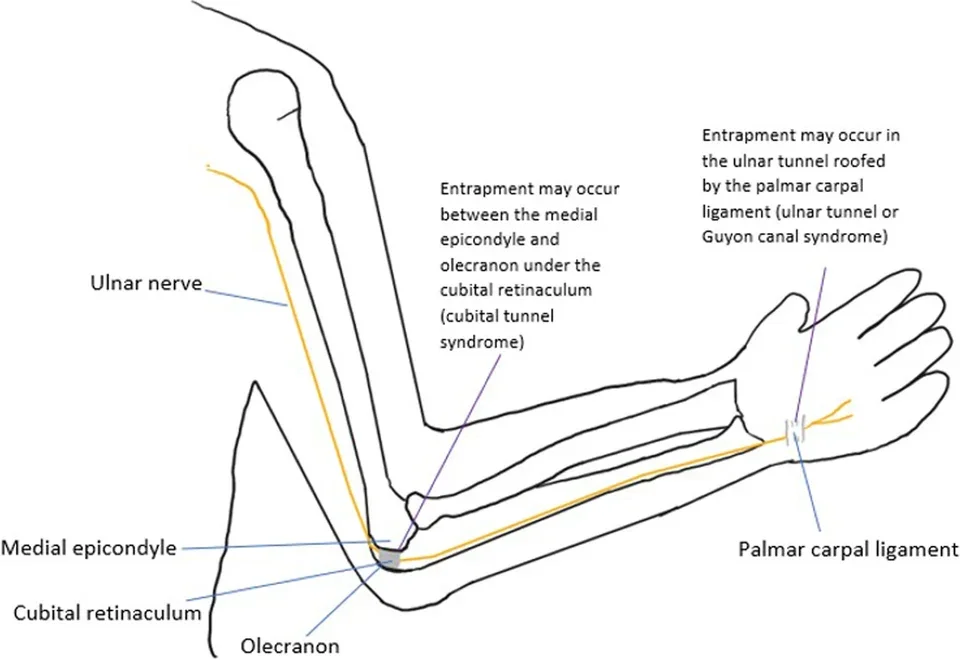
The ulnar nerve runs along the inside of the elbow through a narrow tunnel, just behind the bone: the spot everyone knows as the "funny bone". When the elbow bends, that tunnel narrows and the nerve is stretched. If the nerve becomes trapped there, we speak of cubital tunnel syndrome or ulnar nerve compression. After carpal tunnel syndrome, it is the most common nerve entrapment in the arm.
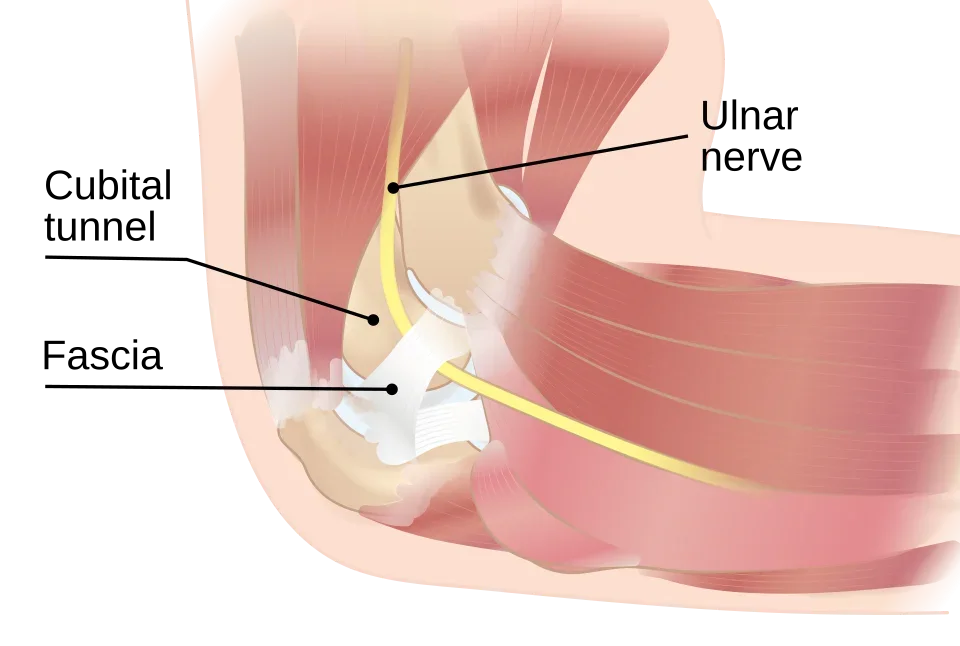
Triggering factors include keeping the elbows bent for long periods (phoning, sleeping with a bent arm), leaning on the elbow, a previous elbow fracture or osteoarthritis, and in some people a nerve that slips over the bone when the elbow bends. Often there is no clear cause.
What symptoms does it cause?
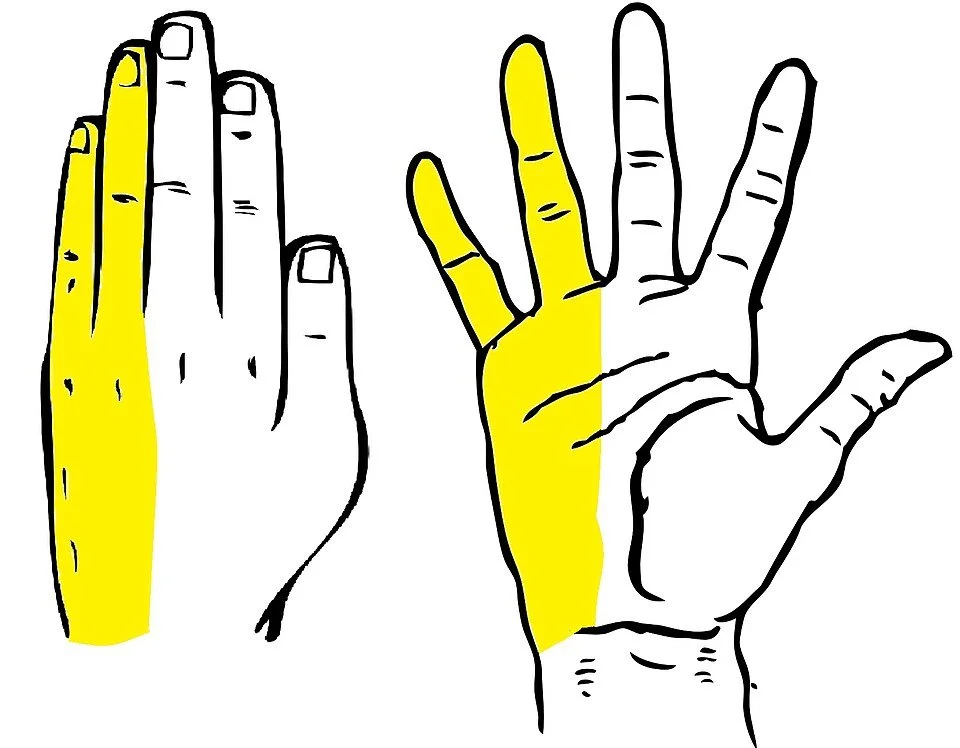
- Tingling or numbness in the little finger and half of the ring finger, often at night or with a bent elbow (phoning, cycling, driving, reading in bed)
- Pain or an electric feeling on the inner side of the elbow, sometimes radiating into the forearm
- Later: loss of strength in the hand, clumsiness with fine movements (doing up buttons, turning a key), difficulty keeping the little finger next to the other fingers
- In advanced cases: wasting of the muscles between the thumb and index finger and in the palm of the hand
Loss of strength and muscle wasting are an important signal: they point to long-standing nerve damage and are a reason not to wait any longer.
How is the diagnosis made?
The pattern of symptoms is often already clear during the clinical examination: which fingers tingle, whether bending the elbow brings on the symptoms, and whether there is already loss of strength. A nerve conduction study (EMG) confirms the diagnosis, locates the entrapment at the level of the elbow, gives an idea of its severity and rules out other causes, such as nerve compression in the neck, at the wrist or a generalised nerve disorder. An ultrasound scan of the nerve can show whether the nerve is thickened or slips out of place. An MRI is only needed if there is doubt about the cause.
Does this need an operation?
Not straight away. For mild to moderate symptoms without loss of strength, a non-surgical approach is the first step, for about three months:
- Explanation of the nerve and of what brings on the symptoms
- Avoiding keeping the elbows bent for long periods and leaning on the elbow; adjusting sleeping position and workplace
- Possibly a night splint or a rolled-up towel around the elbow, so that the arm does not stay bent at night
With these measures, about 8 in 10 patients with mild symptoms improve; with moderate to severe entrapment it is fewer than half. The evidence for a splint or nerve exercises on top of good explanation is limited: in the only comparative study, patients who received explanation and posture advice alone did just as well. A steroid injection has no proven benefit for this nerve.
An operation is proposed when the symptoms persist despite these measures, when the EMG shows clear entrapment, or when loss of strength or muscle wasting occurs. In that last case we do not wait: the longer the nerve stays trapped, the smaller the chance of full recovery.
What operations are there?
Simple release (in situ decompression)
In most patients it is enough to free the nerve where it lies. Through a small incision on the inner side of the elbow, the bands of connective tissue that are constricting the nerve are divided; the nerve itself stays in its natural position. A procedure of 20 to 30 minutes, as day surgery, under local, regional or general anaesthesia. This is the smallest procedure with the fastest recovery, and the technique preferred by the guidelines.
Moving the nerve (anterior transposition)
In a minority of patients the nerve slips over the bone when the elbow bends, or the symptoms return after a previous release. The nerve is then taken out of its tunnel and placed in a new, protected route in front of the bone: under the skin (subcutaneous) or under the flexor muscles of the forearm (submuscular). It is a more extensive procedure (± 60 to 90 minutes) with a longer recovery, and it is reserved for those specific situations.
What does the research say?
Randomised trials show no difference in outcome between a simple release and a transposition: after six to twelve months, about 7 in 10 patients are clearly better, whichever technique was used. There are, however, more wound problems after a transposition (about 1 in 9 versus 1 in 27 after a release). That is why we choose a release as standard, and a transposition only when there is a clear reason for it. Which of the two is advisable for you is determined by the clinical examination and the EMG and is discussed with you beforehand.
What are the risks?
Bleeding after the operation, infection, a tender scar and temporarily reduced feeling in the skin around the incision (due to irritation of a small sensory branch) are the most common. Rarer: persistence or return of the symptoms, a nerve that starts to slip after all following a release, and with a transposition a small risk of problems with the nerve's blood supply. Long-standing numbness or muscle loss does not always recover fully, even after a successful procedure.
How does recovery go?
After a release: the hand can be used straight away for light activities. Desk work and driving after a few days to a week; heavier loads after three to four weeks.
After a transposition: the elbow is relatively spared for the first two to three weeks, sometimes with a removable splint, followed by gradual mobilisation and physiotherapy if needed. Full loading usually after six to eight weeks.
For both: tingling and night-time symptoms often improve quickly, but a nerve recovers slowly, about one millimetre per day. After long-standing entrapment, full recovery can take many months, and with severe, long-standing damage, sensation or strength sometimes does not recover fully. The first aim of the operation is then to stop further deterioration.
Frequently asked questions
Why is it precisely my little finger and ring finger that tingle?
Because the ulnar nerve supplies sensation to exactly those fingers. Tingling in the thumb, index and middle finger fits better with carpal tunnel syndrome, a different condition with a different treatment.
Will I have a release or a transposition?
In most cases a release is enough. A transposition is advisable when the nerve slips over the elbow or when a previous operation did not help enough. The clinical examination and the EMG determine the choice.
How soon can I drive again?
After a release, usually within a few days to a week; after a transposition, by agreement, usually after two to three weeks.
My hand is already weakened. Is there still any point in surgery?
Yes, although the aim is then mainly to stop further deterioration. The earlier the nerve is freed, the greater the chance that strength and sensation recover.
Does a steroid injection help?
For this nerve there is no convincing evidence for it, unlike for carpal tunnel syndrome. That is why we do not routinely offer it.
Can the entrapment come back?
That is rare. If symptoms return, we first check whether the nerve is slipping or is trapped elsewhere; sometimes a transposition is then advisable.